

Sequencing: Playing Your Cards in the Right Order
The same hand can win or lose depending on the order you play it. Sequencing is the skill of ordering your actions to keep the most information and the most options.
Why order matters
Two players can hold the exact same hand and have the exact same board, and one will win the turn while the other bricks, purely because of the order they played their cards. Sequencing is the skill of arranging your actions so that each one is informed by the last and none of them slam a door you might have wanted open. It costs nothing, it is available every single turn, and it is one of the largest skill gaps between strong and average players.
The core idea is simple: do the things that give you information or keep your options open first, and do the things that are irreversible last. Most blown turns come from reversing that order, from committing to a line before you had to and then drawing into a better one you can no longer take.
Information before commitment
Group your plays into two buckets. The first bucket reveals information or keeps your hand flexible. The second bucket is irreversible and changes your hand in ways you cannot undo. Play the first bucket before the second.
- Play first: search cards that let you choose what you get, like Ultra Ball or Nest Ball, and any draw that adds to your hand without throwing the rest of it away. These narrow your uncertainty and let you decide later steps with more information.
- Play last: irreversible actions, especially a hand-shuffling draw Supporter like Professor's Research that discards or shuffles away your current hand. Once you do this, the cards you were holding are gone, so do everything that depended on them first.
Real card examples
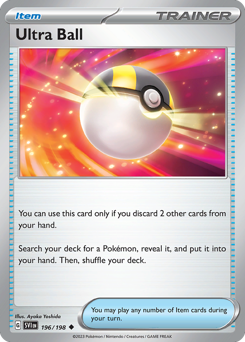
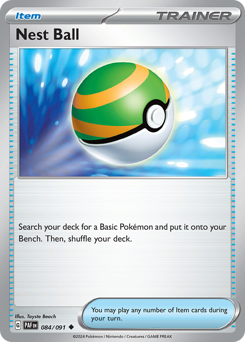
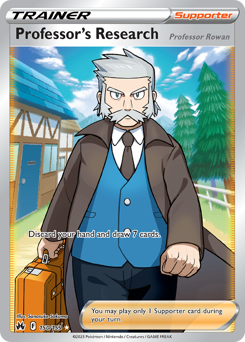
Within the first bucket, prefer the plays that resolve uncertainty. If a search card lets you see and choose, using it early means your later decisions are made with fewer unknowns. The whole point is to push every decision as late as you safely can, so you are always choosing with the most information available.
It helps to picture your turn as a funnel that starts wide and narrows. At the start of the turn you have the most unknowns and the most possible lines. Each play either narrows the funnel by committing you to something, or it keeps it wide by gathering information. You want to spend as long as possible near the wide end. That means front-loading the cheap, free, reversible actions and saving the one big irreversible play, your once-per-turn draw Supporter most of all, until the line is clear. By the time you reach it, you should already know what you want your hand to look like afterward.
Ultra Ball before or after your draw Supporter?
You hold a draw Supporter and an Ultra Ball, and you want a specific Basic. If you play the Supporter first, it might draw you a second copy of that Basic or a card that makes the Ultra Ball unnecessary, and now you have spent a search you did not need and discarded cards for it. If instead you draw with the Supporter first only when the Ball cost is irrelevant, fine, but the safer general line is to use information-gathering and free search before the irreversible refill, so you never pay a cost you could have avoided. Play the cards that inform your decision before the card that erases your hand.
Denying information
Sequencing is not only about what you learn, it is also about what you hide. The order you play in leaks your plan to the opponent. If you gust up a specific Pokémon before you have the energy to punish it, you have announced your target for nothing. If you reveal a tech card early, the opponent can play around it. Good sequencing keeps your intentions ambiguous for as long as possible, so the opponent has to commit to their own line without knowing exactly how you intend to answer it.
This matters most on the turns where the opponent still has decisions to make. The later you commit a telegraphing play, the less time they have to react to it, and the more likely they are to lock in a line that your hidden plan punishes. Holding back a gust effect until the turn you can actually convert it, rather than playing it the moment you draw it, is a classic example: you both keep your own options open and deny the opponent the chance to reposition. Doing the committal, telegraphing plays last serves both goals at once.
Common mistakes
- Drawing before searching: playing a hand-shuffling Supporter before using search, so the search loses access to cards you just shuffled away.
- Attaching Energy before you know your attack: committing an attachment to one attacker, then drawing into a line that wanted the Energy elsewhere.
- Playing your Supporter first out of habit: spending your once-per-turn Supporter at the start of the turn before the rest of the turn has told you which Supporter you actually needed.
How this connects to deckbuilding
Sequencing well is much easier in a deck that gives you safe sequences to choose from. Search redundancy, multiple cards that can find the same piece, means you are rarely forced into a single fragile order where one card has to be played at exactly the right moment or the turn collapses. A deck with thin search and few draw options leaves you with only one viable sequence each turn, and any disruption or bad draw breaks it. When you build, more redundancy in your engine buys you flexibility in how you sequence, which is a real, repeatable edge.
Put it into practice
Build, test, and tune your own Pokémon deck in the TCG Stacked deck builder.
Open the Deck Builder