

Prize Mapping: Planning Your Six-Prize Race
Every game of Pokémon is a race to six prizes. Prize mapping is planning the knockouts that get you there fastest, while making your opponent take the slow route.
What prize mapping is
You win a game of Pokémon by taking all six of your prizes, and you take prizes by knocking out the opponent's Pokémon. Prize mapping is the habit of planning that knockout sequence in advance: which Pokémon you will knock out, in what order, and how many prizes each one gives you. Instead of attacking whatever is in front of you, you work backward from six and ask which path of knockouts gets you there in the fewest turns.
Good players map both sides of the board. They plan their own route to six prizes, and they also track how many knockouts the opponent needs and how easy you are making them. The game is a race, and a race is about relative speed. Taking your prizes one turn faster than the opponent is the whole goal.
Prize values
Not every knockout is worth the same number of prizes. The value of a Pokémon when it is knocked out is what makes prize mapping possible, and what you choose to put on your bench changes the opponent's math as much as your own.
- Single-prize Pokémon give up one prize when knocked out. They hit for less but cost the opponent more knockouts to beat.
- Two-prize Pokémon, such as Pokémon ex, give up two prizes. They tend to hit harder and have more HP, but each one the opponent knocks out moves them a third of the way to winning.
- Three-prize Pokémon give up three prizes. They are the biggest threats and the biggest liabilities at once: knocking one out is half the game.
Real card examples
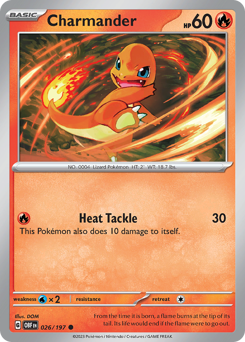
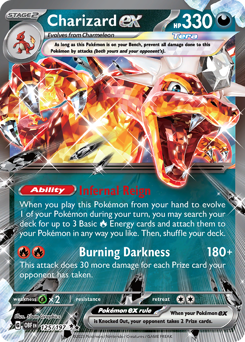
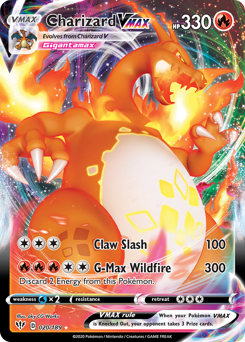
Because a single multi-prize knockout can swing the race so far, what you bench matters enormously. Putting a two-prize Pokémon on the bench early, before you need it, hands the opponent an easy target worth two prizes. The prizes you give up are decided largely by which Pokémon you expose, not just by which ones get attacked.
Common maps
Once you know prize values, prizes resolve into a few common patterns. If your deck attacks mostly with two-prize Pokémon, your map is often the 2-2-2: three knockouts of two prizes each gets you to six. If you mix single-prize and multi-prize attackers, you might run a 1-1-2-2 map, taking a couple of cheap single-prize knockouts early while you set up, then closing with bigger ones. The map you aim for depends on what your deck can reliably knock out and how many turns each knockout takes. Knowing your own most common map tells you how many attacks you actually need to win, which tells you how much time you have.
The map also tells you when you are on a clock. If your route to six needs three knockouts and you have only landed one by mid-game, you know you are behind on tempo and need to find a faster line or disrupt the opponent. If your map is two big knockouts away from six and the opponent is four small ones away, you are ahead and can afford to play safely. Reading the two maps side by side turns a vague sense of who is winning into a concrete count of who reaches six first.
Take one now or set up the bigger knockout?
You can knock out a damaged single-prize Pokémon this turn for one prize, putting you at three prizes taken. Or you can use Boss's Orders to drag up a two-prize Pokémon ex and set up a knockout on it next turn for two. If you take the single now, you are on a 1-1-2-2 pace that needs three more turns. If you instead pressure the ex, you can reach six on a 2-2-2 pace in two more knockouts. Walk the count both ways: the line that reaches six in fewer of your own attacks, given what the opponent can do back, is usually the right one.
Forcing the bad map
The flip side of planning your own route is making the opponent take the slow one. If you attack with single-prize Pokémon, the opponent has to knock out six of them to win, while a deck full of two-prize attackers only needs to lose three Pokémon to lose the game. This is the idea behind the so-called seven-prize line: by forcing the opponent to spend extra knockouts on cheap targets, you can effectively make them take more prizes than the game should require before they ever close it out. Gust effects help you control this on your side too, letting you pick off a key single-prize support Pokémon for a cheap prize, or pull up a target that fits your map instead of the one the opponent wants to defend. Forcing the bad map is about making each of the opponent's knockouts worth less progress than each of yours.
Common mistakes
- Benching multi-prize Pokémon you do not need yet, handing the opponent easy two-prize and three-prize targets.
- Ignoring the opponent's prize count and walking into a knockout that lets them close the game.
- Trading down for no reason: giving up a two-prize Pokémon to knock out a single-prize one when you did not have to.
How this connects to deckbuilding
Your prize map is decided in the deckbuilding stage as much as at the table. The mix of single-prize and multi-prize attackers you choose determines which maps are even available to you, and how many gust effects like Boss's Orders you run determines how often you can reach past the active Pokémon to take the prize you actually want. A deck with no single-prize options can never run the slow, opponent-punishing map, and a deck short on gust effects often cannot force the knockout its map depends on. Decide what prize race you want to run, then build the attacker and gust counts that let you run it.
Put it into practice
Build, test, and tune your own Pokémon deck in the TCG Stacked deck builder.
Open the Deck Builder