

Reading the Meta: How to Analyze the Format
The meta is just the set of decks you are likely to face. Reading it well tells you what to play, what to tech, and what to practice.
What "the meta" means
The metagame, or meta, is simply the set of decks you are realistically likely to sit across from at a given event or in a given format. It is not a list of every deck that can legally be built; it is the handful of archetypes that people actually bring and win with. When players say a card or a deck is "good in the meta," they mean it performs well against the specific opponents you expect to face, not against the field in the abstract.
This distinction matters because you do not build or practice against an imaginary average opponent. You build against real, common decks. A deck that beats the three most-played archetypes and loses to a fringe one is usually a better choice than a deck that beats everything except the most popular archetype. Reading the meta well is what lets you make that trade on purpose instead of by accident.
Where the data is
You do not have to guess what the meta is. Competitive Pokémon TCG results are public, and you can build a reasonably accurate picture of any format from a few sources before you ever shuffle up.
- Tournament results sites: public resources that aggregate decklists and standings from official events. LimitlessTCG is one well-known example of a site that publishes tournament results and decklists, but the general idea is to look at what placed well, not just what was played.
- Usage and conversion: how often a deck shows up (its share of the field) is different from how well it does (its win rate or conversion to the top tables). A deck can be everywhere and still mediocre, or rare but dominant when piloted. Read both numbers, not just popularity.
- Recent events over old ones: the meta moves. Weight results from the most recent events in the current card pool more heavily than older data, because a single set release can reshape which decks are good.
When you read a results page, do not just copy the winning list. Ask why it won. Which matchups did it dodge or beat, what does it struggle against, and is that strength repeatable or did it get a soft bracket? The goal is to understand the format, not to chase one result.
Tiers and the decks to beat
A useful mental model is to sort the format into rough tiers. The top tier is the small group of decks that are both common and strong, the decks you absolutely must have a plan for. The middle tier is the decks that are good but less popular or less consistent. The bottom is everything else: pet decks, brews, and one-off lists that you will rarely see and cannot reasonably plan around. Most of your testing time and most of your tech decisions should be aimed at the top tier, because that is where the majority of your games will actually be decided.
The "decks to beat" are simply the top-tier decks. If you pick up a strong, established archetype, you inherit its known matchups and a body of public knowledge about how to pilot it. If you pick something off-meta, you trade that surprise for the risk of an unknown matchup spread. Neither is wrong, but you should know which bet you are making.
Choosing a tech for a common matchup
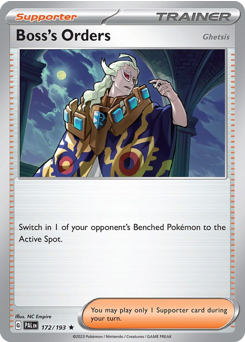
Suppose the most-played deck in your format relies on a single big attacker that takes multiple prizes. You notice your deck wins the game if you can remove that attacker at the wrong moment for them. A gust effect like Boss's Orders lets you pull a benched threat into the Active spot and knock it out before it is ready, swinging a matchup that is otherwise close. Because that matchup is common, adding one or two copies of a gust effect pays off across many of your games, not just one. That is a meta-driven tech: you added the card specifically because of who you expect to face, not because it is generically powerful.
Real card examples
Reading shifts
The meta is never static. New sets add cards that strengthen existing decks or enable entirely new ones, and rotation removes cards that whole archetypes depended on. After a set release or a rotation, last month's data is partly obsolete, and the early results from the new format are the most valuable information you have, even though there is less of it. The players who adapt fastest are usually the ones reading those early shifts instead of trusting a tier list that predates the change.
Shifts also happen within a stable format as players adapt to each other. A deck that dominates one weekend invites counters the next, which can open the door for the decks that beat those counters. This back-and-forth means a healthy read is a moving target. Check the recent data regularly rather than locking in a single picture of the format and assuming it holds.
Common mistakes
- Teching for fringe decks: spending deck slots to beat archetypes you will almost never face, while leaving your common matchups untouched.
- Chasing last week's results: copying the deck that just won without checking whether the field has already shifted to counter it.
- Ignoring your own skill and comfort: picking the statistically best deck even when you cannot pilot it well, when a deck you know cold would win you more games in practice.
How this connects to deckbuilding
Reading the meta is what fills in the flexible parts of your decklist. The core engine of a deck stays largely the same, but your tech slots, your gust counts, and even your Energy counts are decisions you should be making in response to the field. If the meta is full of decks that go wide on the bench, you might lean into more gust effects. If it is full of fast aggressive decks, you might prioritize early consistency over late-game tech. The meta read tells you which of those trade-offs to make, and the deck builder is where you turn that read into an actual sixty cards.
Put it into practice
Build, test, and tune your own Pokémon deck in the TCG Stacked deck builder.
Open the Deck Builder