

Deckbuilding: How to Build a Pokémon TCG Deck That Works
Consistency wins more games than raw power. This guide covers how to structure a 60-card deck so it does what you want, turn after turn.
The job of a deck
A deck has one job before it has any other: do its thing reliably. The most powerful attacker in the format is worthless if you only assemble it one game in three. Before you ask how much damage your deck does, ask how often it sets up on time. Reliability is the foundation, and raw power is what you build on top of it once that foundation holds.
Every card you add is a trade. Sixty slots is not a lot once you account for the engine that finds your pieces, the energy that powers your attacks, and the attackers themselves. Strong deckbuilding is mostly the discipline of spending those slots on what makes your plan happen most of the time, not on cards that shine in rare situations.
The three card groups
A Pokémon deck is built from three card groups, and each has a different role. Getting the balance between them right is the core of deckbuilding.
- Pokémon: your attackers plus the support and evolution lines that get them into play. This is your win condition and the bodies that carry it.
- Trainers: the engine. Draw supporters, Pokémon search, gust effects, tools, and stadiums. This group does the heavy lifting of finding and enabling everything else.
- Energy: basic Energy, special Energy, and any acceleration that lets you attach faster than one per turn. Too little and your attackers sit idle, too much and you draw blanks.
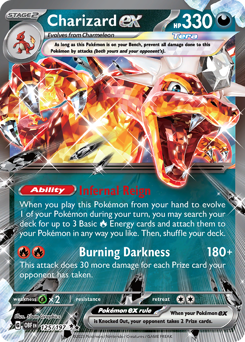
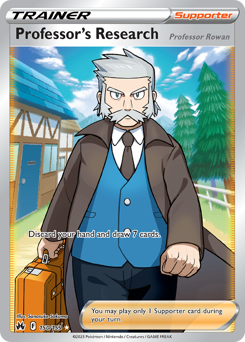

A common modern shape is roughly 12 to 16 Pokémon, 33 to 38 Trainers, and 8 to 12 Energy. Treat that as a starting point, not a rule. A deck that needs a lot of Energy in play will run more of it, a deck with a small attacker count and heavy search can run fewer Pokémon. Start near the common shape, then move counts based on what your deck actually wants to do.
The consistency engine
The engine is the set of Trainers that find your pieces. Draw supporters like Professor's Research and Iono refill your hand, and search cards like Ultra Ball and Nest Ball dig for the exact Pokémon you need. These cards are why a good deck does the same thing game after game instead of relying on lucky draws.
The backbone of the engine is roughly one draw or search action per turn that meaningfully advances your board. Because you may only play one Supporter per turn, your Supporter-based draw is a scarce, once-per-turn resource. You want enough draw Supporters that you almost always have one to play, and enough search that the cards you draw can be converted into the Pokémon you need. When the engine is right, your turns flow. When it is thin, you get stuck holding a hand you cannot use.
A useful way to think about it is hit rate. If your draw and search cards together make up a healthy share of the deck, the odds that any given opening hand contains a way to start your engine climb sharply. That is why competitive lists devote so many slots to Trainers: every extra draw or search card raises the floor of your worst hands. You are not building for the perfect opening, you are building so that even your clunky openings can still function.
A functional turn-1 setup
You open with a Basic attacker active, a bench Pokémon you want to evolve, and a draw Supporter in hand. You play the Supporter to refill, use a search card like Nest Ball or Ultra Ball to add the missing Basic to your bench, attach an Energy, and pass with a board that can attack and evolve next turn. Nothing flashy happened, but every piece is now where it needs to be. That repeatable, boring setup is what a consistent engine buys you.
Evolution lines and ratios
Evolution lines are where consistency quietly breaks. A thin line, for example running fewer copies of a Stage 1 or Stage 2 than the Basic that precedes it, means you will sometimes draw the top of the line with no way to put the bottom into play, or vice versa. The deeper the line, the more copies you generally need to find every piece on time. Cards like Rare Candy can let a Basic skip straight to a Stage 2, which eases the timing of deep lines, but they are not a substitute for running enough of the Pokémon themselves. Plan your ratios so the line assembles on the turn your plan needs it, not several turns late.
Remember the evolution timing rule when you set these ratios: a Pokémon you put into play this turn cannot normally evolve until your next turn. That delay is exactly why thin lines hurt so much. If your Stage 2 attacker realistically comes online a turn or two into the game, every copy of the line you cut pushes that turn later and gives your opponent more free time to set up. Counting an evolution line is really counting how reliably it arrives on schedule, not just whether all the pieces exist somewhere in the deck.
Common mistakes
- Too many one-of cards. A pile of single copies looks flexible but means you rarely draw the specific one you need.
- Too few draw Supporters. If you regularly have no Supporter to play, your engine is undercounted and your deck will stall.
- Over-teching for rare matchups. Slots spent answering a deck you face once a day are slots stolen from your consistency.
- Too much Energy. Past a point, extra Energy just dilutes your draws and gives you dead cards.
- Benching liabilities. Filling your bench with fragile support Pokémon hands your opponent easy prizes if they have a gust effect.
How this connects to deckbuilding
Here, deckbuilding is the whole topic, but it is also where the other fundamentals begin. Your prize math starts in the decklist: the mix of single-prize and multi-prize attackers you choose decides what prize maps are even available to you. Your liabilities start there too, because every thin line and every dead one-of you include is a problem you built in before the game began. Resource management is just spending well during a game what you allocated well when building the deck. Get the list right and the in-game skills get much easier.
Put it into practice
Build, test, and tune your own Pokémon deck in the TCG Stacked deck builder.
Open the Deck Builder