

Disruption: Controlling the Board and the Hand
Disruption is winning by making your opponent unable to play, not just by hitting harder. This guide covers both using it and surviving it.
Winning by denial
Most of the time you win a game of Pokémon by taking prizes faster than your opponent. Disruption is the other lever. Instead of, or alongside, hitting harder, you make it so your opponent simply cannot do what they want to do. A turn where the opponent draws a dead hand, cannot find their attacker, or cannot get Energy onto the board is a turn they did not score, and those lost turns add up the same way knockouts do.
Disruption is most powerful at the seams of the game: when the opponent is setting up, when they are recovering from a knockout, or when they are one card short of a big turn. A disruption play that lands at one of those moments can cost the opponent two or three turns of progress. The same play made when they are already established and flush with resources often does nothing. Timing is most of what separates good disruption from wasted disruption.
Hand disruption
Hand disruption attacks the cards in your opponent's hand, either by shrinking it or by shuffling it away and replacing it with fewer cards. The classic tool is a Supporter like Iono, which has both players shuffle their hands back and draw a number of cards tied to their prize count. Played late, when the opponent has taken several prizes and is holding a carefully assembled hand, it can reduce them to a tiny new hand and erase the setup they spent turns building. The same card played early, when both players draw a full new hand, often helps the opponent as much as you.
The skill in hand disruption is reading when the opponent's hand is valuable and their prize count is low for you to exploit. You are looking for the moment when they have invested in their hand but have not yet cashed it in, and when the math of the shuffle-and-draw leaves them with fewer cards than they need. Throwing it out on autopilot wastes one of your most powerful tools.
Board disruption
Board disruption attacks what is in play rather than what is in hand. The most common form is the gust effect, and it is the backbone of most aggressive game plans.
- Gust effects: a card like Boss's Orders pulls a benched Pokémon into the Active spot, letting you target a fragile support Pokémon or a not-yet-ready attacker instead of whatever the opponent chose to defend with. This both scores prizes on your terms and forces the opponent to rebuild.
- Energy denial and tempo hits: attacks or effects that remove Energy, or that knock out a Pokémon the opponent just invested attachments into, set them back by the resources they have to replace. Even without a gust, a well-timed knockout on a key piece is a tempo disruption.
- Attacking the setup, not the wall: the point of board disruption is to ignore the defensive choice the opponent wanted you to attack and instead hit the thing they were trying to protect.
Real card examples
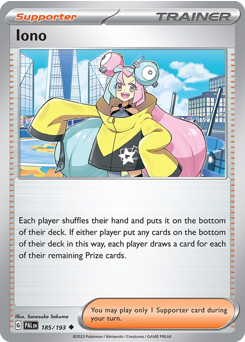
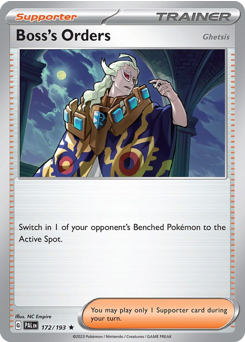
Gust effects are also what make prize math go your way: by choosing the target, you decide whether you take an easy single-prize knockout or reach past the wall for the multi-prize piece that ends the game faster.
A late hand-refresh that locks a rebuilding opponent
Your opponent is ahead on prizes and has only a couple left to take, but they just lost their main attacker and are rebuilding. They have spent the turn assembling a hand of search and recovery pieces to get back online next turn, and they are sitting on several useful cards. You are behind. On your turn you play a hand-refresh effect like Iono, which has each player shuffle their hand away and draw cards equal to their own remaining prize count. Because the opponent has few prizes left, they draw only a tiny new hand and lose the recovery they spent the turn building, while you, with many prizes left, draw a large hand to work with. With few cards and no attacker, they may whiff their recovery entirely, buying you the turns you need to climb back into the prize race. The disruption did not deal damage, but it cost them the turn that would have closed out the game.
Playing around disruption
The flip side of using disruption is surviving it, and most decks will face hand disruption every game. The defense is sequencing and banking. If you expect a hand-shrinking effect, do not stockpile a fragile hand of pieces you have not used yet. Play out what you can safely commit, get your board established, and keep only the cards you actually need, so that if your hand does get reset you lose as little progress as possible.
You can also bank resources onto the board ahead of a likely reset. Energy attached to a Pokémon, Pokémon already in play, and tools already equipped all survive a hand refresh, because they are no longer in your hand. When you read that the opponent is likely to disrupt, converting your hand into board state before they can shuffle it away turns their disruption into a much smaller swing. The general rule is the same as in sequencing: do the committal, board-building plays before the opponent gets a chance to wipe your hand, not after.
Common mistakes
- Disrupting when ahead on board for no gain: spending a Supporter to disrupt when you are already winning the board and would have been better served drawing into your next play.
- Emptying your hand into a known disruptor: dumping cards onto the table or holding a fat hand right before a predictable hand-refresh, then losing the cards you should have banked or used.
- Using disruption on autopilot: playing a hand-shrink effect every time you draw it, regardless of timing, instead of saving it for the turn it actually breaks the opponent.
How this connects to deckbuilding
How much disruption to run is a deckbuilding decision, and it depends on what you are trying to do. A deck that wins by setting up a wall and grinding wants enough gust effects to reach past the opponent's defenders, often a couple of copies, plus a hand-disruption Supporter to lean on when ahead. A deck that wins by raw speed may want fewer disruption pieces and more pure consistency, because every disruption slot is a slot not spent on finding its own engine faster. When you build, decide how central denial is to your plan, then commit enough gust effects and hand-control Supporters to make that plan reliable, without crowding out the cards that keep your own deck running.
Put it into practice
Build, test, and tune your own Pokémon deck in the TCG Stacked deck builder.
Open the Deck Builder